Styled shelves have a way of looking like a designer breezed through and worked some quiet magic — books, objects, and open space all falling into an arrangement that feels effortless and personal. The secret isn't talent or a stylist's budget; it's a handful of repeatable moves anyone can learn. Once you know them, you'll never look at a shelf the same way again.
Clear everything and start fresh#
The first move that separates a pro from an amateur is the most counterintuitive: take everything off the shelves. It's tempting to nudge what's already there, but a shelf styled by shuffling clutter still looks like clutter. Pull it all down, wipe the surfaces, and spread your books and objects out where you can actually see what you're working with. A blank slate lets you build with intention instead of negotiating with whatever happened to land there.
While everything's out, edit. This is the step most people skip, and it's where great styling really begins. Not everything earns a spot on the shelf — a shelf isn't an obligation to display every object you own. Sort your books into piles, gather the objects genuinely worth showing (a beautiful bowl, a candle, a framed photo, a small sculpture, a healthy plant), and set aside the things that are really just storage. The goal is a curated slice of what you love, not a full inventory. When you put back only your best pieces, every shelf has room to look considered.
Starting empty also frees you from the old arrangement's gravity. You'll find pairings and placements you'd never have discovered by rearranging things in place, and the finished shelf will feel intentional rather than accumulated.
Think in small vignettes#
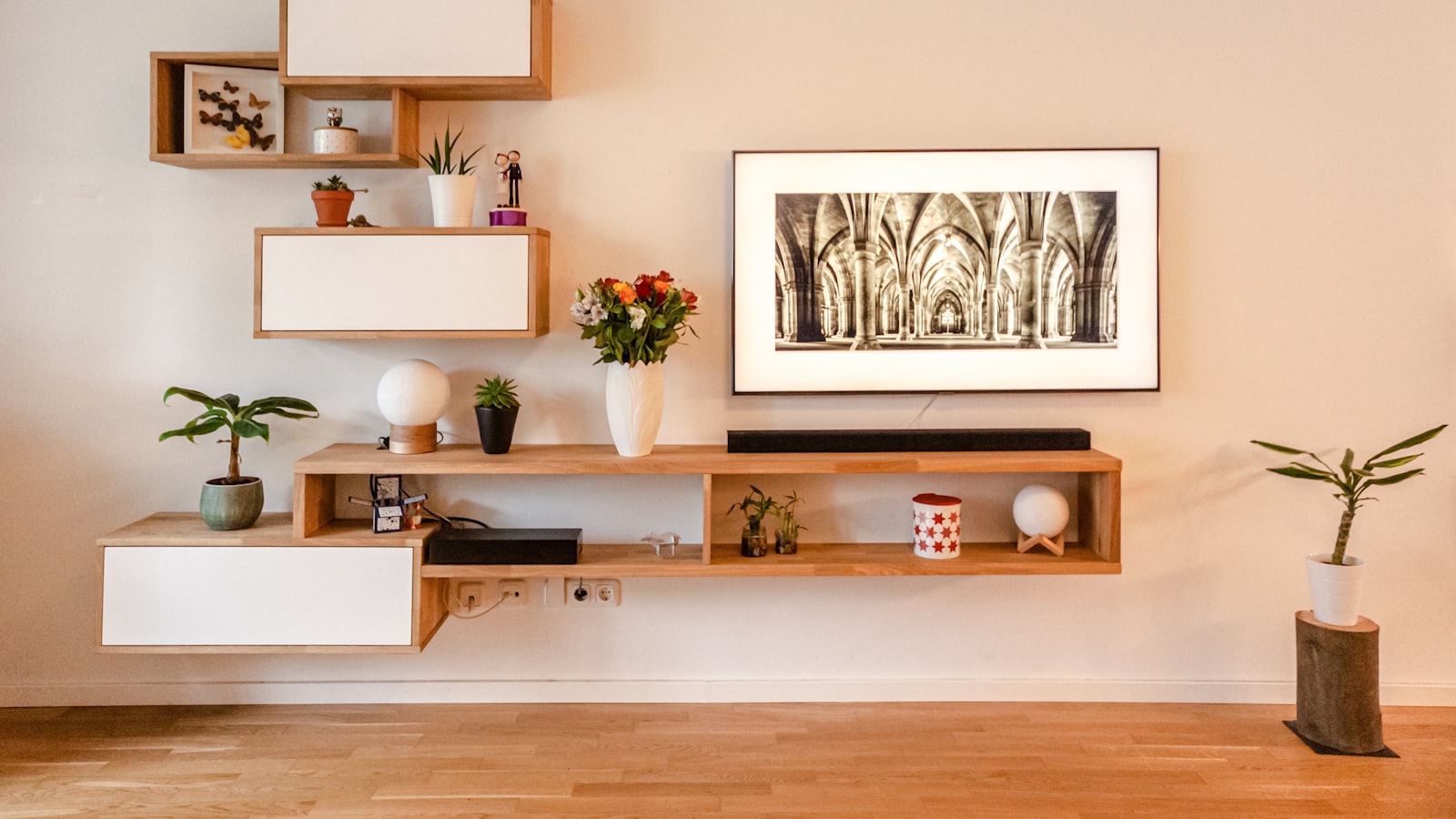
Here's the mental shift that makes shelf styling click: stop thinking about the whole bookcase at once and start thinking in small vignettes. A vignette is a tiny, self-contained grouping — a few objects arranged together to feel like a little still life. Each shelf might hold one or two of these little scenes, and when you build them one at a time, the overwhelming task of "style the whole thing" becomes a series of small, manageable arrangements.
The classic stylist's tool inside a vignette is the rule of three. Odd numbers, and three in particular, tend to feel more natural and dynamic to the eye than perfectly even pairs. So group objects in threes: a stack of books, a vase, and a small plant; a candle, a bowl, and a framed photo. Within each trio, vary the heights so the eye moves up and down rather than skating across a flat line — something tall behind, something medium, something low in front, arranged in a loose triangle. That little staircase of heights is what gives a vignette its quiet rhythm.
A beautifully styled shelf isn't one perfect arrangement — it's a series of small, confident moments that happen to share a bookcase. Build them one at a time and the whole thing falls into place.
Let your books pull their weight here, too. Stand some upright and lay others in horizontal stacks, which break up rows of spines and double as little pedestals — set a small object on top of a stack to give it a stage and some lift. That mix of vertical and horizontal is one of the simplest tricks for making shelves look professionally arranged.
Let the shelves breathe#
If there's one mistake that instantly marks a shelf as amateur, it's cramming every inch full. A packed shelf gives the eye nowhere to rest, and the pieces you love get lost in the crowd. The pros know that empty space isn't wasted space — it's what lets each object stand out. Negative space around a vignette frames it and makes it feel chosen rather than crammed in.
So as you place things, deliberately hold some space back. A few shelves can be fuller, but others should stay open and airy, and almost every shelf benefits from a clear stretch where the eye can pause. This restraint is genuinely hard, because there's always one more book or object you could squeeze in, but it's exactly what separates a curated shelf from a stuffed one. A few habits that keep shelves breathing:
- Leave at least some open space on most shelves rather than filling them wall to wall.
- Give each vignette a little room around it so the groupings read as separate moments.
- Vary how full each shelf is so the whole unit has a relaxed, uneven rhythm.
Think of the empty stretches the way a good conversation uses pauses — they do real work, letting the things you care about actually be seen. When in doubt, take something off rather than adding something on.
Add personality, texture, and a final look#
With your vignettes built and your spacing breathing, the last layer is what makes the shelf unmistakably yours. A few personal objects — something with sentimental value, a treasure found while traveling, art leaned casually instead of hung, a photo that makes you smile — give the whole arrangement warmth and a story. This is the moment a shelf stops looking like a furniture catalog and starts looking like it belongs to a real person.
Texture and material variety add the polish. Mix smooth ceramic against rough wood, a soft plant against hard metal, matte finishes against a touch of shine, so the arrangement has depth. Greenery is especially forgiving — a single trailing plant softens an otherwise stiff shelf and adds literal life. Color can help too: a loose palette, or a few books grouped by tone, calms a busy bookcase without making it feel rigid. Just resist piling on too many tiny objects, which tips a styled shelf right back into clutter.
Then comes the move that ties it all together — the step-back. Place a few things, walk to the other side of the room, and look at the whole bookcase as one composition. Does your eye travel comfortably across it, or does it snag? Is one side heavy while the other floats? Adjust, then step back again. Styling is a conversation between placing and looking, and you simply can't judge it from three inches away. Photographing it on your phone helps even more, because the screen flattens the arrangement and reveals the balance you might miss in person.
No shelf is ever truly finished, and that's the joy of it. Swap pieces with the seasons, slide in a new book you loved, retire an object that's gone stale — a styled shelf is a living thing, and tinkering with it is half the fun. Clear it out, build in vignettes, leave room to breathe, and finish with a few pieces that tell your story, and you'll end up with shelves that look effortless precisely because you took the time to care.