A small bedroom has one big advantage: it is already halfway to feeling cozy. The trick is making it feel restful and uncluttered rather than cramped, and that comes down to a few sensible decisions made in the right order. Get the bed, the color, and the storage right, and the square footage stops mattering.
Start with the bed, not the decor#
The bed is the largest thing in the room, so where it lands shapes everything else. Resist the urge to start with cushions and art. Stand in the doorway and look for the wall that lets the bed sit comfortably with at least a little room to walk on the side you get in from. In most small rooms that means tucking the headboard against the longest unbroken wall, often opposite or beside the window so you wake up to light.
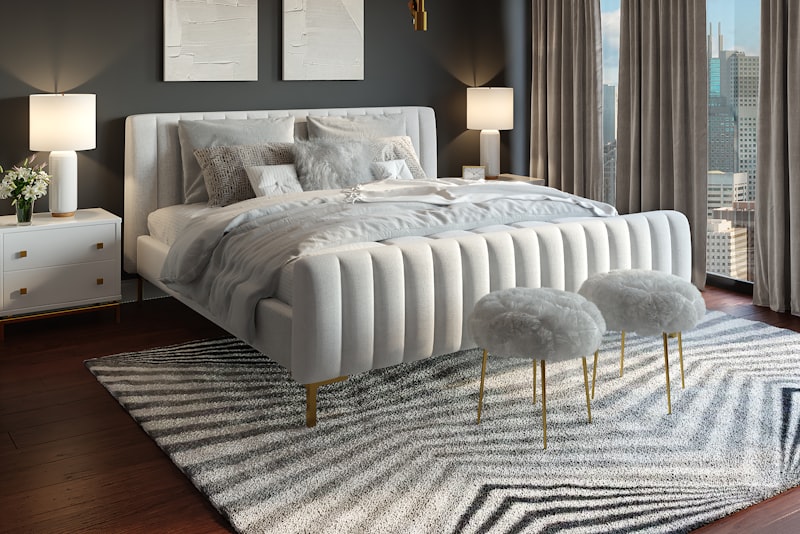
Be honest about the size of the bed itself. A frame that swallows the floor will make the whole room feel like a mattress with a path around it. If a smaller frame gives you a real walkway and somewhere to set a lamp, that breathing room is usually worth more than the extra inches of mattress. Choose a frame with legs or an open base where you can — letting the floor show underneath reads as far airier than a solid block sitting flush to the ground.
Once the bed is placed, everything else falls into line: the nightstand fits where it fits, the lamp follows, and you are decorating around a fixed point instead of guessing.
Think about the approach to the bed too, not just where the headboard lands. You want to be able to make it, get into it, and move around it without turning sideways or climbing over a corner. If the only way to reach both sides is to squeeze past a wall, consider whether a nightstand on one side and a slim shelf on the other might serve you better than matching tables that pinch the walkway. Small rooms reward this kind of asymmetry — it looks relaxed and it leaves you room to move.
Use color and light to push the walls back#
In a tight room, contrast is what makes the walls feel close. Soft, closely related tones blur the edges so your eye does not stop at every corner, and that quietly makes the room feel larger than it measures.
Empty wall and ceiling space is not wasted in a small bedroom — it is the breathing room that keeps the whole space from feeling full.
That does not mean everything has to be white. A small bedroom can absolutely go deep and moody and feel like a cocoon, as long as you carry the color consistently and light it well. The principle either way is continuity: pick a direction and let walls, trim, and bedding live in the same family rather than chopping the room into competing zones.
Then layer the light. A single ceiling fixture flattens the room and leaves dark corners that shrink it. Free up your nightstands by mounting reading lights or sconces on the wall, add a low warm lamp for evenings, and the room gains both depth and a sense of calm after dark. A mirror placed to catch the window will bounce daylight around and visually borrow space you do not actually have.
Take your storage up the walls#
Clutter is the real enemy of a small bedroom, and floor-hogging dressers are often the cause. The fix is to think vertically. The walls are full of unused space, and using them frees the floor that makes a room feel open.
A few moves do most of the work:
- Use the space under the bed for flat bins or drawers so off-season clothes disappear
- Hang a tall, narrow shelf or wall hooks instead of widening furniture across the floor
- Mount nightstand alternatives — a small shelf or wall ledge — to keep the floor clear
- Choose one dresser that goes up rather than out, and let it earn its footprint
The goal is for everything to have a home so the surfaces you see stay mostly clear. A bedroom where the floor and the tops of furniture are calm will always feel more spacious than one of the same size buried in stuff. If a piece does not store something or bring you real joy, it is probably costing you space you would rather have.
If you are tempted to build in shelving, wardrobes, or anything that involves wiring for lights, that is the point to bring in a licensed professional rather than improvising — it protects both your home and your deposit.
Add personality without crowding it#
A calm, well-edited room still needs to feel like yours, and small rooms reward restraint here. Fewer, larger gestures read as intentional, while a scatter of tiny objects reads as busy. One generous piece of art above the bed does more than a crowded grid of little frames. One healthy plant on a shelf beats five jostling for space.
Lean into texture instead of clutter to make the room feel rich. A nubbly throw, a linen duvet, a soft rug your feet land on in the morning — these add warmth and depth without taking up visual room the way more objects would. Keep the things you actually use within reach and let the rest go. A book you are reading, a lamp, a single beautiful object on the nightstand is plenty.
A small bedroom does not ask you to do more — it asks you to do less, and to do it well. Place the bed thoughtfully, keep the color soft and continuous, send your storage up the walls, and let just a few things you love do the talking. Do that, and you end up with the best kind of small room: one that feels intimate and tucked-in by choice, the room you are genuinely glad to close the door on at the end of the day.