A small living room is where a home does its most important work — it's where you unwind, gather, and welcome people in. The challenge is fitting comfort and seating into a tight footprint without the room feeling crowded. The answer isn't squeezing in less; it's choosing the right pieces, at the right scale, in the right places, so the room feels open, warm, and entirely yours.
Measure before you fall in love#
The most common small-room mistake is buying furniture that looks perfect in the showroom and overwhelms the room at home. A sofa that's a touch too deep, a coffee table that's a hair too wide, and suddenly there's nowhere to walk. So before you fall for anything, get out a tape measure and learn your room's real numbers — wall lengths, doorway widths, the path from the entrance to the window, the spots where outlets and radiators sit.
Then map it out before you buy. Mark the footprint of a sofa or table on the floor with tape and live with it for a day. Can you walk around it comfortably? Does it block the light or the view? This costs nothing and saves you from the heartbreak of a beautiful piece that simply doesn't fit. In a small space, the right dimensions matter more than the right look, because the wrong scale ruins even the loveliest furniture.
Scale down thoughtfully. A loveseat or a compact three-seater often serves a small room far better than a deep sectional that eats the entire floor. Slimmer arms, a lower back, and shallower depth all reclaim inches you'll feel every day. The aim is furniture that fits the room's proportions, so the space feels balanced rather than stuffed.
Anchor the room, then build around it#
Every living room needs an anchor, and in a small one that's almost always the sofa. Place it first, give it the best spot — usually the longest clear wall or facing the room's focal point — and let everything else arrange itself around that decision. Trying to place every piece at once leads to a muddle, while anchoring with the sofa gives the whole layout a logical starting point.
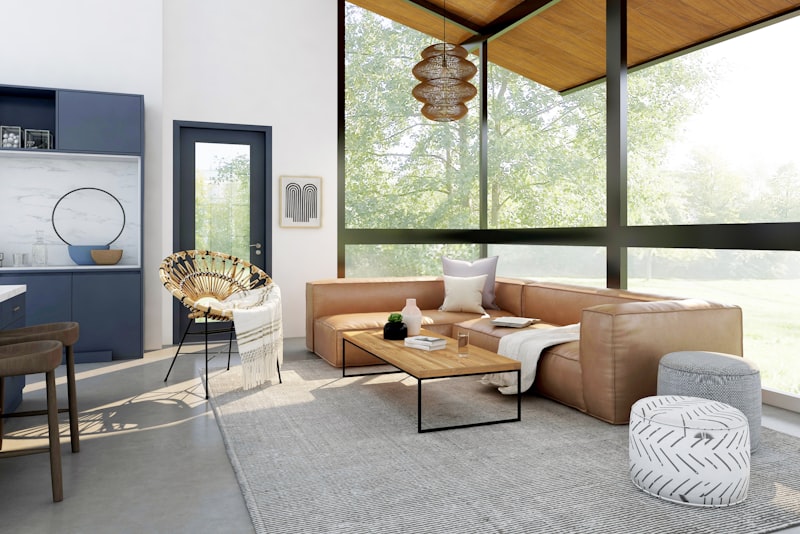
Resist the reflex to push everything flat against the walls. It seems like it should open up the middle, but a thin ring of furniture around a vacant center often makes a room feel like a waiting area. Pulling the sofa even slightly off the wall, and floating a chair at an angle, creates a more intimate, conversational arrangement that actually uses the space better. Keep clear walkways so you can move through without weaving around obstacles, and aim a sightline from the doorway across the room toward something pleasant.
A small living room doesn't need more furniture to feel complete — it needs a few well-placed pieces that leave room to move and breathe.
Mind your focal point. Whether it's a window, a fireplace, or the wall you'll hang art on, orient the seating to face it so the room has a clear sense of direction. When furniture relates to a focal point instead of floating randomly, even a tiny room feels composed and purposeful rather than improvised.
Choose pieces that work twice as hard#
In a small living room, every piece should earn its footprint, ideally by doing more than one job and by taking up as little visual weight as possible. The furniture that flatters a compact space is light on its feet — literally and figuratively — leaving floor and sightlines open so the room breathes.
Favor pieces raised on legs. A sofa, chair, or console lifted on slim legs lets light and floor flow underneath, which reads as far airier than a solid block sitting flush to the ground. Glass and open frames practically vanish, making them ideal for a coffee or side table in a tight spot. Then look for double duty wherever you can find it:
- An ottoman that opens for storage and serves as a footrest or extra seat
- Nesting tables that pull apart for guests and tuck away after
- A slim console behind the sofa that holds books, lamps, and a drink
- Stools that slide under a table and pull out when company arrives
That extra, flexible seating is the quiet hero of a small living room. Rather than crowding the space with permanent chairs, a couple of poufs or stools give you somewhere to seat friends when you need it and disappear when you don't. The result is a room that comfortably hosts more people than its size suggests, without feeling packed on an ordinary evening.
Layer in warmth and comfort#
A small living room furnished only for efficiency can feel a little thin, so the final job is making it inviting. Comfort doesn't require more furniture — it comes from soft layers, good light, and a few personal touches that signal this is a place to settle in. This is where the room stops being a floor plan and starts being a home.
Textiles do the heavy lifting. A soft throw over the sofa arm, a couple of cushions you actually want to lean on, a rug that grounds the seating — these add depth, warmth, and a sense of welcome without taking up real estate. A rug sized to sit under at least the front legs of your furniture pulls the whole arrangement together and makes the area feel deliberate rather than scattered.
Lighting sets the mood after dark. One overhead fixture flattens a room and leaves cold corners, while a lamp or two at different heights wraps the space in a warm glow that makes it feel cozy and complete. Light the corners, add a candle, and the smallest living room becomes somewhere you genuinely want to linger. If you ever consider new wiring or wall fixtures, leave that to a licensed electrician and stick to plug-in lamps yourself.
Finish with the things you love — a plant, a stack of books, a piece of art, a photo that makes you smile. These personal notes are what make a furnished room feel lived-in and real. Furnish your small living room this way, measuring with care, anchoring with a right-scale sofa, choosing pieces that work twice as hard, and layering in genuine comfort, and you'll end up with a space that feels just right. Not cramped, not bare, but warm, welcoming, and exactly the size you need to live well.